Tree Time
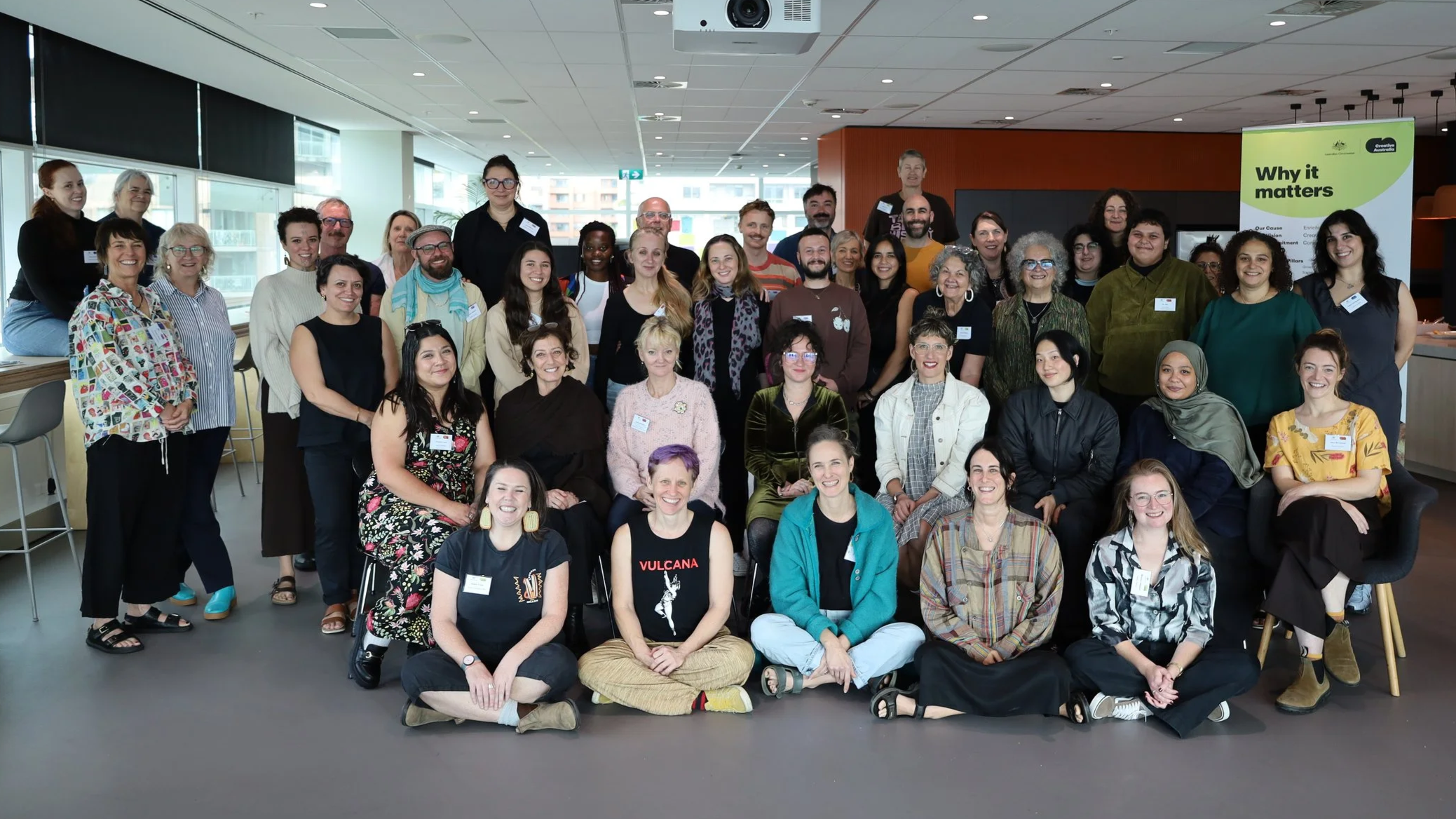
The following is an excerpt of a speech I made at Creative Australia’s CACD National Gathering on 23 April, 2026 on Gadigal Country.
Intro
As I talk about working in place – and in time – I acknowledge that Aboriginal and Torres Strait Islander people always have – since the beginning of time – cared for this place. This always was and always will be Aboriginal land. I send big love and big respect to their elders.
I grew up on Jinibara country, in the small regional town of Mt. Mee. While only 500 people live there, it is not remote. When I was growing up we could drive to a supermarket in an hour - now you get to one in 20 minutes. My dad was the teacher at the local small school, his dad was also a teacher… Mum’s dad was a fisherman… I spent a lot of my childhood barefoot in the bush, and on old fishing boats in Moreton Bay
Since then, I have mostly been an independent artist and producer, with lots of my work being overseas – especially in Korea and Mongolia. I’ve made children’s theatre, and facilitated community arts projects… some of which are more on the “socially engaged art” end of the spectrum, while others are more on the CACD end of the spectrum.
What to talk about?
When meeting Yamane and Allisar for the first time last week we had a brainstorm about what I might talk about...
Transcultural collaboration came up - but I let that go because it would be weird for me to talk about that without the rest of my collective - our whole concept is the interweaving of perspectives and without them you’d just get my white, queer, country boy perspective.
Working with children also came up, but none of us – including me – mentioned that in our pre-gathering forms… so you narrowly escaped an embarrassing workshop on play.
Instead, I’ve chosen the simple and small concept of TIME. I’ll start with the little blurb I sent through:
I'm interested in speaking about time. I see time as a key component of CACD practice, but I also see it is under threat... Time-based funding, managerialism, a "time is money" culture, and rigid approaches to time can limit our opportunities to be creative together, reduce the time we have to act on what we care about, and restrict our imagination. How does clock time (the rigid, chronological, “straight line” understanding of time) diminish CACD? Can CACD help to reimage time? What can we learn from queer time, crip time, and different understandings of time? What is the speed of trust and friendship? Is time running out for CACD? Is time running out?
On reflection – this was probably a little too ambitious! But here’s the plan… I’m going to talk about one component of my Creative Australia Fellowship - an effort to save some old gum trees on Mt Mee - and as I go, I’m going to share questions that arose for me about time and CACD. These questions will become some options for provocations amongst your small groups.
So here goes!
Tree Time
About a year ago, a neighbour shared on facebook that she had heard that some mature gum trees on Mt. Mee were going to be removed by the Department of Transport and Main Roads. She called a meeting in an old cow paddock where the local woodchopping family have set up a great coffee cart. We all agreed the mature trees were not “roadside hazards” but things of great beauty worth protecting.
From here, a group of locals formed who wanted to save the trees. I found myself taking minutes for a group of women, including a retired teacher and a retired bikie. We did all the usual things: wrote letters to MPs, started a petition, made t-shirts.
On Saturday mornings, we continued to meet in the cow paddock café, and more and more locals were showing up to support the cause.
Local birdwatchers started visiting the trees and documenting wildlife. They painted the native nesting birds they spotted on recycled election signs and put them up around the trees.
A local farmer sent a drone up, and captured footage of a sugar glider in one of the gum’s hollows.
I worked with the trees’ neighbours, a local librarian, a local lawyer, and a local extinction rebellion activist.
We met with TMR – who told us that the plan was set and nothing would change their mind. This is the same Queensland government who:
Stopped QLD’s path to treaty talks as soon as they were elected
Banned gender affirming care for trans young people
Has now banned pro-Palestinian phrases
The extinction rebellion guy concreted pipes into the earth at the base of the trees for us to lock on to. They were designed so that we could not be cut off… we would need to be dug out.
At the same time, I was occasionally volunteering with the Friends of D’agular National park, and at Woodford Folk Festival… I heard more about and was inspired by Woodford Folk Festival’s 500 year plan… I started to think about the tiny scale, and short-term nature of our project to save these trees…
In a time of overlapping environmental, political, economic, and social crisis… what is it like to plan for the next 500 years, as well as the next 1 year?
On the day of the planned tree removal, a bunch of locals showed up to get in the way of the chainsaws and bulldozers. Volunteers put on a big breakfast. We did an intro to non-violent direct action, and we decided who amongst us was willing to be arrested. I was.
When tree loppers didn’t arrive, we started tree-sitting. I camped at the trees most nights for a few weeks, and we had a roster of tree sitters supervising the trees 24/7.
We didn’t know TMR’s plan, but we knew that when they arrived, the tree-sitters would send out the message to a list of locals who were standing by to arrive.
Small photography projects emerged.
A community alter was assembled for people to add to, and use as a space to appreciate what we stand to lose.
People camped together and shared meals at the trees.
A neighbour dropped of hot raisin toast to my van on her way to school drop off.
There was no timeline, no deadlines – just waiting – with purpose – and being together, or being alone with the trees.
I started to see how this “always open” approach was more accessible for many community members… A Jinibara elder stopped by after a board meeting for a yarn… she introduced the birds that joined our talk, and shared what they meant to her. Seniors popped in with baked treats for chats… children visited after school to add protest signs to our growing collection… there were no workshop times, no excel schedules… it made some of my other community projects look so controlled and rigid. We were operating outside clock time.
How do we interrupt clock time to embrace country time, queer time, crip time, and different approaches to time in CACD?
I reflected on how this project could never get funding through the normal avenues. We had no idea who was going to be involved or what we were going to do. We had no organisations partnering with us. We had no funding, but did raise about $5k in donations for lawyer fees along the way. Most importantly, we didn’t even know we were going to do it… no funding cycle is responsive enough to support activity that is just suddenly happening and suddenly urgent! So…
Is project planning that requires all elements to be pre-determined limiting our imagination in CACD? How are we finding other ways? Does funding ever ruin community arts?
As well as delaying the tree removal, the community pressure resulted in TMR arranging a proper environmental assessment of the site. In the background, Kabi Kabi people were also quietly doing their business – and it is likely their work that influenced the decision makers most.
Eventually, the state government made an announcement that they would change their plan, and leave the old gums alone. There was a party under the trees to celebrate.
While we’re proud of this outcome – and it felt like a huge win for us - I realise how tiny this is in the bigger picture… as old growth forests are cleared across the world, as sacred trees are being destroyed… We were just so pleased the native bird eggs would have a chance to hatch.
How do our local environmental efforts connect to global efforts?
What strategies exist to make our hyper local impact, global?
Some CACD efforts have largely focused on social outcomes through cultural activities, with less environmental objectives…
What supports CACD to achieve environmental outcomes, alongside the social and cultural outcomes? What approaches to time help with these efforts?
I was only able to spend so much time on this project because I was on the fellowship. Usually I am juggling multiple contracts and projects in order to maintain an income, and usually I would not be able to be so available to respond to things in the moment. Sometimes I am doing work outside of my passion and skillset for income. I started to realise how my paid work, while often rewarding, can also be a trap that takes time away from caring for what I care about… these other commitments that I do for income, sometimes feel less creative, and less impactful… which makes me wonder:
How do we free up time for CACD artists over extended periods of time, so they can follow their calling, respond immediately, and make real impact through their practice?
Throughout this project, I made new friends. I’ve started to think about what creative thing we can do together next – perhaps to celebrate and document the win we had with the trees. This will be a slow project – occurring in the gaps of our busy schedules – at our own pace – without a predetermined plan – through volunteering – and separate to the arts industry… guided by our desire to stay connected and protect what we care about.
What does moving at the speed of friendship look like?
What if our projects grew at the speed of a forest?
How do these tempos interact with a fast-paced world?
When is relational and seasonal practice too slow?
So, after a year and half back home on the mountain… I am left with these questions about time… my own time, our time for our CACD work with our communities, and the time we have left to protect all that we stand to lose. I wonder…
Where and when is CACD most liberated from the clock?
Thankyous
Aunty Julie Jones Webb, Zohar Spatz, Yaman Fayed, and Alissar Chidiac
M’ck McKeague - the person I have been talking about time with for half of my life (so far).

The Regional Arts Fund (RAF) is an Australian Government program designed to benefit regional and remote arts practitioners, arts workers, audiences and communities. The fund is managed through Regional Arts Australia and is administered in Queensland by Flying Arts Alliance.
Creative Australia - My work at Mt. Mee was assisted by the Australian Government through Creative Australia, its principal arts investment and advisory body.